Early 1600s - Spanish twenty-one
Miguel de Cervantes described players of "veintiuna", or twenty-one, providing an important early written reference to a European card game based on reaching twenty-one.
Last updated: 04 October 2026
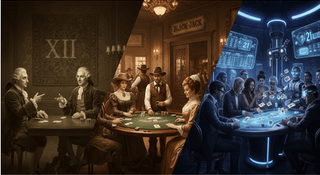
Modern blackjack developed over centuries rather than appearing as a single invented game. Its history can be traced through earlier European "twenty-one" games, their development in North America and the rules that eventually became familiar at casino blackjack tables.
This guide follows that development from the earliest documented predecessors through Las Vegas, mathematical basic strategy and card counting to online and live dealer blackjack. It also separates well-supported history from some of the stories that have become attached to the game.
← Swipe to view full table →
| Casino | Live Dealer | Crypto | USA? | Best For |
|---|---|---|---|---|
| Sloto'Cash | Visionary iGaming | ✅ | ✅ | Dedicated blackjack bonus |
| Lucky Elf | Betterlive, Evolution, Platipuslive, Lucky Streak | ✅ | ❌ | Huge blackjack selection |
| Roaring 21 | Visionary iGaming | ✅ | ✅ | USA & Canada players |
| Blackjack Ballroom | Evolution, Pragmatic Live | ❌ | ❌ | Long-established reputation |
Blackjack's history is more interesting when uncertain stories are treated as uncertain rather than repeated as fact. There is good evidence connecting the modern game with earlier European "twenty-one" games and later developments in North American casinos, but some familiar stories - particularly the supposed promotional hand that gave blackjack its name - are much harder to establish. The important history is not a single moment when blackjack was invented, but the gradual evolution of its rules, mathematics and casino culture.
 Sloto'Cash
 Lucky Elf
 Roaring 21
 Blackjack Ballroom
Blackjack does not have a single known inventor or an exact starting date. Its ancestry is usually traced through several European card games in which players tried to reach a target total without exceeding it. One particularly important early reference comes from Spain: Miguel de Cervantes described a game called "veintiuna" - Spanish for twenty-one - in a story written in the early 17th century.
The French game "vingt-et-un", also meaning twenty-one, became established during the 18th century and is generally regarded as an important predecessor of modern blackjack. Its rules were not identical to today's casino game, and different forms of twenty-one developed as the game spread between countries and gambling venues.
The origin of the name "blackjack" is less certain. A frequently repeated story claims that American gambling houses once offered a special payout for a particular twenty-one containing a black jack, and that the promotional name survived after the bonus disappeared. The story is widely circulated, but the evidence for it is disputed, so it is better treated as a possible explanation rather than an established fact.
Forms of twenty-one were being played in North America by the 19th century, although the rules varied considerably between places and periods. As organised gambling developed, the game gradually acquired features associated with modern blackjack, including more standardised dealing procedures, house rules and payouts.
Casino gambling was legalised in Nevada in 1931, and the later growth of Las Vegas helped establish blackjack as one of the major American casino table games. During the 20th century, rules became more formalised while casinos introduced variations involving deck numbers, dealer actions, doubling, splitting and blackjack payouts.
Blackjack continued to change as casinos responded to new playing strategies and technology. Multi-deck shoes and more frequent shuffling affected card counting, while electronic and online versions eventually separated the game from the physical casino table. Live dealer blackjack later combined online betting with cards dealt by human dealers in streamed studios.
Blackjack developed gradually, so many dates in its early history refer to documented predecessors rather than to the modern game itself. These are some of the better-established milestones in that development.
Miguel de Cervantes described players of "veintiuna", or twenty-one, providing an important early written reference to a European card game based on reaching twenty-one.
The French game "vingt-et-un" became established during the 18th century. Although its rules differed from modern blackjack, it is commonly identified as one of the game's principal predecessors.
Versions of twenty-one were played in North America during the 19th century. Rules and terminology continued to vary as the game developed within American gambling culture.
Nevada legalised casino gambling in 1931. As Las Vegas expanded over the following decades, blackjack became one of the table games closely associated with the city's casinos.
Roger Baldwin, Wilbert Cantey, Herbert Maisel and James McDermott published mathematical work on optimal blackjack play in 1956. Their research helped establish that blackjack decisions could be analysed systematically rather than relying on intuition.
Edward O. Thorp's Beat the Dealer brought card counting to a much wider audience. His work showed that the changing composition of the remaining cards could, under suitable conditions, be used to identify situations more favourable to the player.
Organised card-counting teams became a prominent part of blackjack culture. Groups including those later associated with the MIT Blackjack Team used coordinated approaches to advantage play, while casinos developed increasingly sophisticated countermeasures.
The growth of internet casinos brought software-based blackjack to players outside physical casinos. RNG blackjack allowed rapid digital play, while later live dealer technology introduced streamed tables with human dealers.
Smartphones, faster internet connections and improved video streaming made blackjack increasingly accessible on mobile devices. Live dealer studios expanded significantly, giving online players access to numerous blackjack tables, variants and betting limits.
Edward O. Thorp became one of the most influential figures in blackjack history with the publication of Beat the Dealer in 1962. Building on earlier mathematical work on basic strategy, Thorp used probability, computer-assisted analysis and casino testing to show that the changing composition of a blackjack deck could be tracked and exploited under suitable conditions.
Thorp's work helped bring card counting from mathematical research into popular awareness. His early systems were more complicated than many counting methods used later, but the central principle was important: when proportionally more high-value cards remain to be dealt, some situations become more favourable to the player.
The publicity surrounding card counting also changed the relationship between casinos and skilled blackjack players. Casinos experimented with rule changes and increasingly used measures such as multiple decks, earlier shuffling and surveillance to make advantage play more difficult. Card counting nevertheless continued to develop, eventually producing simpler systems and organised team approaches.
Thorp did not invent blackjack basic strategy. Roger Baldwin, Wilbert Cantey, Herbert Maisel and James McDermott had published their mathematical analysis several years earlier. Thorp's major contribution was demonstrating how information about the cards already dealt could potentially be used on top of correct basic-strategy play.
Blackjack never settled into one universal set of rules. As the game developed, casinos adopted different numbers of decks, dealer rules, doubling and splitting options, surrender rules and payouts for a natural blackjack. These differences produced many of the blackjack rule sets still encountered today.
Some changes were particularly significant. Multi-deck shoes became increasingly common during the 20th century, while rules such as whether the dealer hits or stands on soft 17 continued to vary between casinos. Blackjack payouts also became less uniform, with some tables replacing the traditional 3:2 payout with alternatives such as 6:5.
Distinct games including European Blackjack, Spanish 21, Double Exposure and Pontoon developed their own combinations of rules and payouts. These variations matter because blackjack strategy depends on the rules being played rather than on a single strategy applying perfectly to every table.
See the Blackjack Game Variants guide for a closer comparison of modern variants and their rule differences.
Edward Thorp was not the only player to influence blackjack culture. Professional gamblers and authors including Stanford Wong and Ken Uston helped bring advantage play to a wider audience during the 1970s and 1980s. Their books discussed card counting, team play and the continuing contest between skilled players and casino countermeasures.
Team-based card counting became particularly famous through groups associated with students and former students from MIT and other universities. Rather than every player making conspicuously large bets, teams could divide roles between players who tracked the cards and others who placed larger bets when conditions became favourable.
Blackjack's reputation for being mathematically beatable also made it unusually attractive to writers and filmmakers. Ben Mezrich's 2002 book Bringing Down the House, inspired by the experiences of members of an MIT-associated blackjack team, became a bestseller and was later adapted loosely into the 2008 film 21.
Those stories helped turn card counting into part of popular casino mythology, although films often make advantage play look rather more glamorous and straightforward than it is. The lasting cultural significance is that blackjack became associated not only with gambling, but with the idea that mathematics and disciplined decision-making could sometimes challenge the casino's built-in advantage.
Blackjack's early history is not documented as neatly as its modern mathematical development. These sources provide useful background on the game's origins, rules and some of the major developments covered in this guide:
Blackjack does not have one known inventor or an exact starting date. Its ancestry can be traced through European twenty-one games, including the Spanish "veintiuna" described by Miguel de Cervantes in the early 17th century and the later French game "vingt-et-un".
The origin of the name is uncertain. A widely repeated story says American gambling houses once offered a special payout for a twenty-one containing a black jack, with the promotional name surviving after the bonus disappeared. The evidence for this explanation is disputed, so it should not be treated as established fact.
Nevada legalised casino gambling in 1931, and blackjack became increasingly associated with Las Vegas as the city's casino industry expanded during the following decades.
Roger Baldwin, Wilbert Cantey, Herbert Maisel and James McDermott published important mathematical work on optimal blackjack strategy in 1956. Their research preceded Edward Thorp's better-known work on card counting.
Edward Thorp did not invent blackjack mathematics, but his 1962 book Beat the Dealer demonstrated practical card-counting methods and brought the idea to a much wider audience. His work showed how information about cards already dealt could potentially identify situations more favourable to the player.
Online blackjack emerged with the growth of internet casinos during the 1990s and 2000s. Software-based RNG games were followed by live dealer blackjack, which uses streamed video to connect online players with human dealers and physical cards.
No. Blackjack rules have continued to evolve, with differences in deck numbers, dealer actions, doubling, splitting, surrender and payouts. These variations are important because they can change both the house edge and the correct playing strategy.
Interested in more gambling and casino history? See our History Of Baccarat, History Of Roulette and History Of Video Poker guides, plus How Online Gambling Has Changed.
Use basic strategy to choose when to hit, stand, double down, split or surrender based on your hand and the dealer's upcard.
Read GuideLearn how card counting works, when it can be used, and why it does not apply to most RNG blackjack games.
Read GuideLearn how blackjack bonuses work, including wagering requirements, game contribution rates and restrictions that can affect their value.
Read GuideManage a blackjack bankroll with practical guidance on stakes, session limits, losing runs and responsible bet sizing.
Read GuideLearn when a blackjack bonus may be worth claiming, how different terms affect play and when playing without a bonus can make more sense.
Read GuideIdentify common blackjack mistakes involving strategy, betting, table rules, side bets, bonuses and bankroll management.
Read GuideLearn what to check when playing blackjack on a phone or tablet, from game choice and usability to live dealer performance.
Read GuideSee how live dealer blackjack works, how it differs from RNG blackjack and what to check when choosing a live table.
Read GuideCompare Classic, European, Atlantic City and other blackjack variants, including the rule differences that can affect how each game plays.
Read Guide