How to Read an Online Casino Paytable
Last updated: 09 October 2026
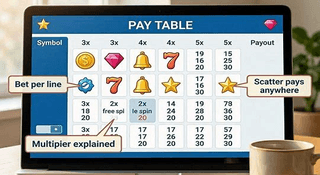
Every online slot and video poker game has its own payout rules, but they are not always obvious from the screen. The paytable explains which combinations win, how much they pay and what triggers special features. Knowing how to read it can prevent costly misunderstandings before you start playing.
This guide shows you where to find a casino game's paytable, how to interpret slot symbols and payouts and what to look for in video poker. We'll also walk through practical examples, explain the connection with RTP and highlight the details worth checking before placing a bet.
Quick Picks: Casinos for Exploring Different Games
Casino Beacon Opinion
A paytable is one of the most useful parts of a casino game, yet it is also one of the easiest to ignore. A minute spent checking it before playing can reveal far more than the graphics, theme or promotional description ever will.
The most useful details are not necessarily the biggest advertised prizes. Pay attention to how wins are formed, what the wild and scatter symbols actually do, how bonus features trigger, and whether changing the bet affects any payouts or features. With video poker, even small differences between paytables can materially affect the game's long-term return.
There is no need to memorise every payout before playing. The important habit is knowing where to find the paytable and checking anything that could affect how the game plays or what you are risking. If the rules are difficult to understand, choosing a different game is always an option.
What Is a Casino Paytable?
A casino paytable explains how a game awards prizes. It shows which winning combinations qualify for payouts, how much they are worth and which special rules affect the result. Although paytables differ between games, their purpose is the same: to explain what you are betting on and how winnings are calculated.
In online slots, paytables usually cover symbol values, paylines or win ways, wilds, scatters and bonus features. In video poker, they list the payouts for different poker hands, often across several coin levels. Table games generally provide payout rules for individual bets, including any optional side bets.
You can normally find this information by opening the game's Info, Help, Paytable or i menu. Some games divide the information across several screens, so check both the payout chart and the game rules.
| Game Type | What to Look For |
|---|---|
| Online slots | Symbol payouts, winning combinations, paylines or win ways, wilds, scatters, free spins and bonus rules |
| Video poker | Winning poker hands, payouts at each coin level, royal flush bonuses and differences between game versions |
| Table games | Betting options, payout odds, special rules and side bet payouts |
Why Reading the Paytable Matters
Two casino games can look remarkably similar but use completely different payout rules. Reading the paytable before playing helps you understand those differences, recognise winning combinations and avoid making assumptions based on another game.
This becomes particularly important with modern slots, where cascading reels, expanding wilds, multipliers and bonus features can change how wins are calculated. Video poker presents another challenge: two versions of the same game may have different payouts for identical hands.
Checking the paytable can help you:
- Understand exactly which symbol combinations or poker hands qualify for payouts
- Check how wilds, scatters, multipliers and bonus features work
- Recognise whether bet size or coin selection affects particular prizes
- Compare payout rules between different versions of the same game
- Avoid confusing advertised maximum prizes with typical winning amounts
- Make more informed decisions about your bankroll and betting limits
How Slot Paytables Work
Slot paytables explain which symbols create winning combinations, how those combinations are formed and what each one pays. They also describe special symbols, free spins and other features that can affect the result of a spin.
The exact layout varies between games, but there are six important things to look for.
1. Top-paying symbols
Most slots have premium symbols that pay more than the ordinary symbols. The paytable normally shows how much you receive for matching three, four or five of each symbol. Some games also award prizes for two matching premium symbols.
Payouts may be displayed as cash amounts, coin values or multipliers of your bet. Always check which format the game uses before comparing the numbers.
Example: Reading a Slot Paytable
Imagine a fictional five-reel slot with a $1 total stake per spin. Its paytable shows the following prizes for matching symbols on a winning payline. In this example, all payouts are expressed as multipliers of the total $1 stake, not the individual payline bet.
| Symbol | 3 Matching | 4 Matching | 5 Matching |
|---|---|---|---|
| Diamond | 1x | 5x | 20x |
| Gold Crown | 0.8x | 4x | 15x |
| Ruby | 0.5x | 2x | 10x |
| Playing Card | 0.2x | 1x | 5x |
Here's how to interpret the figures with a $1 total stake:
- Three diamonds: 1x your stake = $1 payout
- Four gold crowns: 4x your stake = $4 payout
- Five rubies: 10x your stake = $10 payout
- Five diamonds: 20x your stake = $20 payout
These figures represent total payouts, not profit. A $10 payout from a $1 spin leaves you $9 ahead on that spin. If several paylines win simultaneously, their payouts may be added together according to the game's rules.
2. Wild symbols
Wild symbols usually substitute for ordinary symbols to complete winning combinations. However, they may not replace scatters or bonus symbols. Some wilds also carry multipliers, expand across reels or remain in place for several spins. Check the paytable to see exactly how they behave.
3. Scatter symbols
Scatters often trigger free spins, bonus rounds or instant prizes. Unlike ordinary symbols, they may award wins anywhere on the reels rather than along a payline. Check how many scatters are needed, whether they must appear on particular reels and what happens when they land.
4. Bonus features and free spins
The paytable or game rules should explain how bonus features are activated and what happens during them. Look for free spin multipliers, expanding symbols, retrigger opportunities and any special conditions that affect payouts.
5. Paylines, win ways or clusters
Not every slot forms winning combinations in the same way. Traditional slots may use fixed paylines, while others award prizes for matching symbols on adjacent reels or in clusters. Check whether wins must begin on the leftmost reel, can form in both directions or follow another rule.
6. Bet level effects
Many slots scale their payouts in proportion to your stake, but some jackpots or features have additional betting conditions. Check whether changing your bet affects eligibility for particular prizes, not just the amount you could win.
How Video Poker Paytables Work
Video poker paytables list the winning poker hands and how much each one pays. Unlike most slots, video poker also involves decisions about which cards to hold and discard, so both the payout structure and your playing strategy affect the game's long-term return.
One of the most important things to understand is the difference between full-pay and short-pay versions of the same game. A few seemingly small changes to the paytable can make a noticeable difference over thousands of hands.
Example: 9/6 vs 8/5 Jacks or Better
Jacks or Better is a useful example because different versions often have almost identical paytables. The names 9/6 and 8/5 refer to the payouts for a full house and a flush. A 9/6 game pays nine coins per coin wagered for a full house and six for a flush, while an 8/5 game pays eight and five respectively.
| Winning Hand | 9/6 Jacks or Better | 8/5 Jacks or Better |
|---|---|---|
| Royal Flush | 4,000 | 4,000 |
| Straight Flush | 250 | 250 |
| Four of a Kind | 125 | 125 |
| Full House | 45 | 40 |
| Flush | 30 | 25 |
| Straight | 20 | 20 |
| Three of a Kind | 15 | 15 |
| Two Pair | 10 | 10 |
| Jacks or Better | 5 | 5 |
The table shows payouts for a five-coin bet. Notice that most winning hands pay exactly the same in both versions. The differences are limited to two hands:
- Full house: 45 coins in the 9/6 version versus 40 coins in the 8/5 version
- Flush: 30 coins in the 9/6 version versus 25 coins in the 8/5 version
With a $1 coin denomination and five coins wagered, you would stake $5 per hand. A full house would return $45 on the 9/6 game but only $40 on the 8/5 version. The same flush would pay $30 or $25 respectively.
Under standard rules and with optimal strategy, 9/6 Jacks or Better has a theoretical return of approximately 99.54%, compared with approximately 97.30% for 8/5 Jacks or Better. Those percentages describe long-term mathematical expectations, not what you should expect to receive during an individual session.
What Else Should You Check?
Before choosing a video poker game, look beyond the payouts for a full house and flush. Different games have their own hand rankings, special rules and strategies.
- Whether the royal flush pays a larger amount when five coins are wagered
- Whether the game uses the standard Jacks or Better hand rankings or a different set of rules
- Whether your strategy chart matches the exact game and paytable
- Whether payouts change when you select a different coin denomination or number of coins
For more detailed comparisons, see our Video Poker Paytables & Payouts guide. You can also explore how the rules differ between games such as Deuces Wild, Bonus Poker and Double Double Bonus in our Video Poker Variants guide.
How Paytables Relate to RTP and Volatility
A paytable explains what a game pays for particular results, but it does not necessarily reveal how often those results occur. This distinction matters when trying to understand return to player (RTP) and volatility.
Paytables and RTP
RTP is the theoretical percentage of wagered money a game returns over a very large number of plays. A slot with 96% RTP, for example, is mathematically designed to return an average of $96 for every $100 wagered over the long term. Individual sessions can produce very different results.
Some slots display their RTP in the information or help menu, while others do not. You generally cannot calculate a slot's RTP from its symbol payouts alone because you would also need to know the probabilities of the different winning outcomes.
Video poker is different. Its paytable, together with the game's rules and the probabilities of drawing particular hands, can be used to calculate theoretical returns for a given playing strategy. This is why the 9/6 and 8/5 Jacks or Better comparison above is so important.
Paytables and Volatility
Volatility describes how much a game's results tend to fluctuate. Lower-volatility slots generally produce smaller, more frequent wins, while higher-volatility games tend to have greater swings between wins and losses.
A paytable featuring very large multipliers or substantial jackpot prizes may suggest the possibility of bigger swings, but it cannot confirm a game's volatility by itself. You would also need information about how frequently different outcomes occur.
For a deeper explanation, see our RTP and house edge guide and slots volatility guide.
Common Mistakes Players Make When Reading Paytables
Even when players open a paytable, it is easy to overlook details that affect how a game works or how much a winning combination pays. These are some of the most common misunderstandings worth avoiding.
- Assuming all wilds work alike: Wild symbols can have different substitution rules, multipliers and special effects depending on the game.
- Misunderstanding scatters: Some scatter symbols pay anywhere, while others must appear on particular reels or in specific combinations to trigger a feature.
- Confusing paylines with win ways: A winning combination on a fixed-payline slot may not qualify for a payout under another game's rules.
- Misreading payout multipliers: A prize shown as 20x might refer to the total stake, the bet per line or another betting unit. Check which applies.
- Focusing only on the jackpot: A large maximum prize tells you little about how frequently it occurs or the game's overall RTP.
- Ignoring video poker paytable differences: Two games with the same name can have different full house, flush or other hand payouts.
- Overlooking coin and bet requirements: Some prizes or features depend on the number of coins wagered or the selected stake.
Quick Checklist Before You Play
You don't need to memorise an entire paytable. Before playing an unfamiliar slot or video poker game, run through these basic checks to make sure you understand its payouts and rules.
- Open the game's paytable or help menu before placing a real-money bet
- Identify which symbols or poker hands qualify for payouts
- Check how winning combinations are formed and how payouts are calculated
- Read the rules for wilds, scatters, multipliers and bonus features, where applicable
- Confirm whether changing your stake or coin level affects any prizes
- Look for the game's RTP information and any available volatility rating
- Make sure the minimum stake and betting options suit your bankroll
If the payout rules are unclear, don't feel obliged to play. Choose a game you understand and set your betting limits before you start.
FAQ: How to Read an Online Casino Paytable
What is a casino paytable?
A casino paytable is the information screen that explains how a game works, what different symbols pay, how bonus features trigger, and what rules apply to wins.
Why should I read the paytable before playing?
Reading the paytable helps you understand which combinations win, how payouts are calculated and whether special rules affect your bet. It can also prevent misunderstandings about bonus features, multipliers and betting requirements.
Does the paytable show the RTP?
Sometimes. Some online slots display their RTP in the paytable or help menu, while others only show symbol payouts and game rules. A slot's RTP cannot usually be calculated from the paytable alone because the probabilities of different outcomes are also needed.
How do I know which symbols pay the most?
The paytable normally lists symbols from highest to lowest value and shows how much each one pays for matching combinations. Premium symbols and jackpot symbols usually appear near the top.
What should I check first on a slot paytable?
Start by checking the top-paying symbols, wilds, scatters, bonus triggers, paylines or win ways, and any special rules about bet size, multipliers or free spins.
How are video poker paytables different from slot paytables?
Video poker paytables focus on poker hand rankings and the payout for each winning hand, while slot paytables focus on symbols, paylines and feature triggers. In video poker, small paytable changes can make a big difference to long-term returns.